
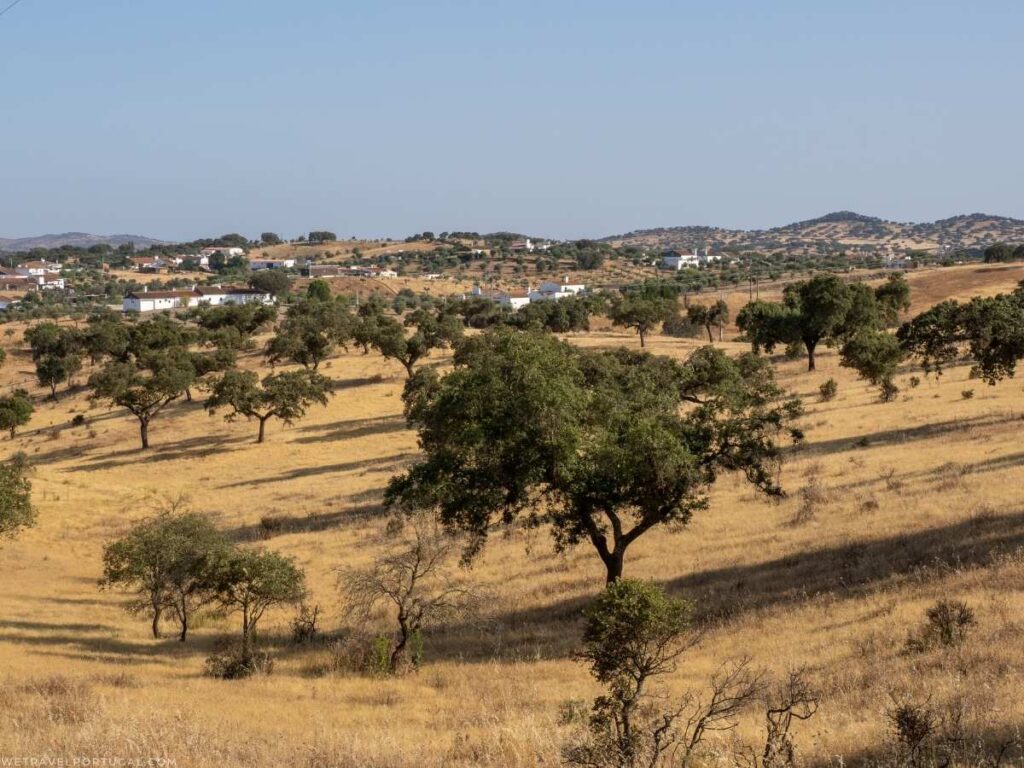
The Alentejo region, stretching across southern Portugal, is a land of rolling plains, whitewashed villages, and rich historical heritage. It is is widely known for its slow-paced lifestyle, vineyards, and exceptional cuisine. Stretching from the Tagus River to the Algarve and east to the Spanish border, it offers a slower, more rural experience than Lisbon or the Algarve – but its size means careful planning is essential. This guide covers the best places to visit, the region’s food and craft traditions, where to stay, when to go and how to explore by road or public transport.
Understanding the Alentejo
The name Alentejo means “beyond the Tagus.” It is Portugal’s largest region by area and one of its least densely populated, stretching from the Atlantic coast to the Spanish border.
Its destinations are widely dispersed, so most visitors focus on one or two parts of the region during a single trip. Évora and the central Alentejo offer historic towns, wineries and prehistoric sites; the Alqueva area is known for hilltop villages, lake landscapes and stargazing; northern Alentejo is shaped by fortified towns and the Serra de São Mamede; and the coast offers beaches and long-distance walking routes.
With a population of just over 700,000, it’s also one of Portugal’s least densely populated. If you need a break from the hotspots of the Algarve, and bustle of Lisbon, then heading into Alentejo will give you some space!
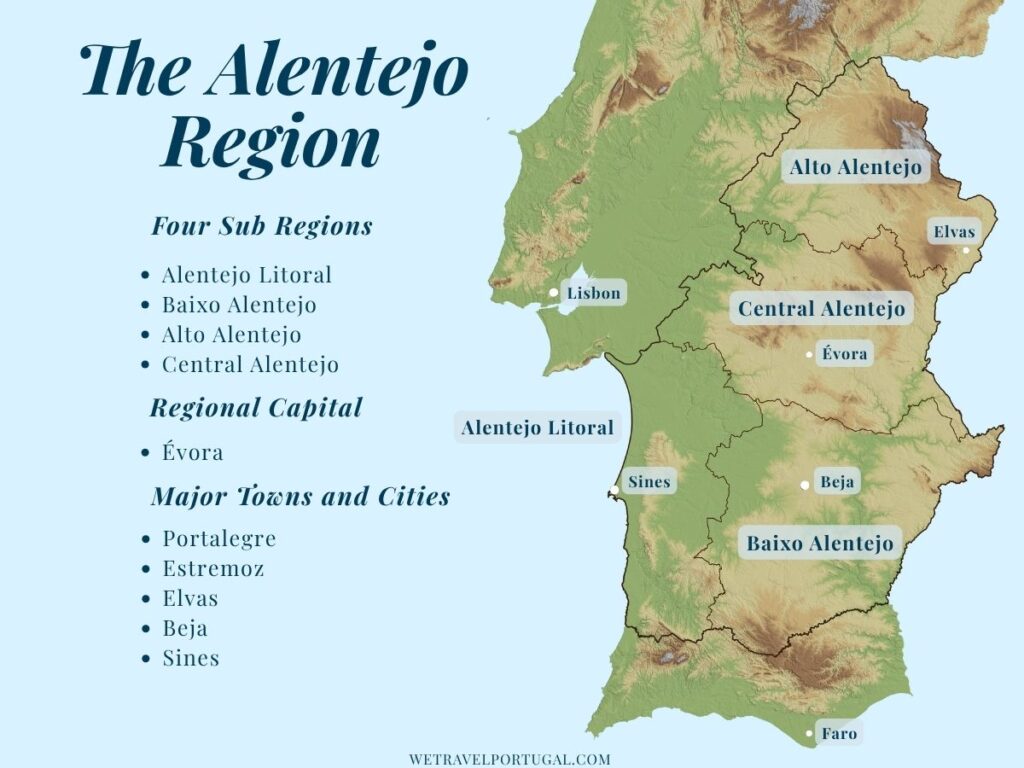
Alentejo’s Sub-Regions
The Alentejo is divided into four sub-regions, the most northern Alto Alentejo, Central Alentejo, the coastal Alentejo Litoral, and the southern Baixo Alentejo.
Discover the Alentejo’s Crafts and Artisans
The Alentejo’s craft traditions are closely tied to the materials and landscapes of this surprisingly diverse region. In São Pedro do Corval, one of Portugal’s best-known pottery centres, visitors can browse family-run workshops and watch artisans shape and paint pieces by hand. Elsewhere, Arraiolos is known for its embroidered rugs, Estremoz for its distinctive clay figures, and Nisa for pottery decorated with tiny white stones.
Cork, wool, leather and traditional cowbells also remain important parts of the Alentejo’s craft heritage and identity. Visiting workshops and buying directly from local producers is one of the best ways to support these skills while taking home something genuinely connected to the Alentejo.

The Best Places to Visit in the Alentejo
The Alentejo is celebrated for traditional crafts such as pottery and tapestry, as well as its wine, cork and agricultural production. Regional staples include olive oil, bread and porco preto, the meat of the Alentejano black pig. For a taster, let’s explore some of the most popular and charming spots in the Alentejo.
Évora – UNESCO World Heritage City
Évora is the region’s largest city and the most practical base for first-time visitors. Its walled historic centre, a UNESCO World Heritage site since 1986, contains the Roman Temple, the cathedral and the Chapel of Bones.
The city deserves at least a full day to explore, while its central location makes it a great place for visiting nearby wineries, the Almendres megalithic complex, and smaller towns like Estremoz, Vila Viçosa and Monsaraz.

Beja – The Gateway to the Alentejo
Beja is a small city that’s commonly referred to as the gateway to the Alentejo (if you’re heading north from the Algarve). You’ll find the ruins of a medieval castle, as well as history that goes much further back in the city’s museums.
Monsaraz – A Hilltop Village Above Lake Alqueva
The medieval village of Monsaraz should be on everyone’s Alentejo bucket list. Perched on a hilltop above Lake Alqueva, Monsaraz offers sweeping views across the surrounding plains and reservoir. Inside its historic walls, narrow streets lead past whitewashed houses, small restaurants, wine bars and the main castle – Castelo de Monsaraz.

Lake Alqueva – Inland Beaches and Water Sports
Lake Alqueva is one of Europe’s largest reservoirs and one of the best places to escape the Alentejo’s summer heat. Its shores offer river beaches, boat trips, kayaking and paddleboarding, while nearby villages such as Monsaraz and Mourão provide historic viewpoints over the water.
Dark Sky Reserve, Alqueva
The low population density of the Alentejo, and long distance to the nearest population centres means Lake Alqueva has a remarkable absence of light pollution. This makes it the only Dark Sky Reserve in Portugal, and an exceptional place for stargazing. The reserve covers multiple municipalities, but you’ll also find an observatory in the small village of Cumeada, near Reguengos de Monsaraz. It is equipped with cutting-edge telescopes for solar and astronomical observation, as well as hosting experts to help guide you through the nights sky.

Mértola – Alentejo’s Rich Roman and Moorish History
To dive into some of the deeper history of the region, a visit to Mértola is a must. Mértola sits above the Guadiana River, which farther south forms part of the border between Portugal and Spain. Its archaeological remains and museums reveal the town’s importance under Roman, Islamic and medieval Christian rule.
Elvas – A UNESCO Border Town
Elvas is another of the Alentejo’s UNESCO heritage gems. Elvas was originally a fortified border town just 12km from the Spanish border. Its now recognised as the largest bulwarked dry ditch system in the world. On a hill above the town is the incredible pentagonal fortress of Forte de Nossa Senhora da Graça. Which combined with Elvas’ castle, and Forte de Santa Luzia on the opposite side of the town makes it one of the most formidable towns in Portugal. In 2012, the town and its fortifications were added to the list of UNESCO World Heritage sites.

Almendres Cromlech – A Major Prehistoric Site Near Évora
Looking for something mysterious or even spiritual? The Cromeleque dos Almendres is a megalithic complex located near Évora. It consists of a prehistoric stone circle made up of 95 stone monoliths which makes it one of the largest in Europe. It’s an ancient site, and reported to be up to 8,000 years old, offering a fascinating and different glimpse into the past than anywhere else in the Alentejo.

Castelo de Vide
Castelo de Vide is a small hill town known for its medieval castle, whitewashed streets and well-preserved former Jewish quarter. It also provides a useful base for exploring the Serra de São Mamede and nearby Marvão. The Serra de São Mamede is the highest mountain range south of the Tagus River, and was romantically nicknamed the ‘Sintra do Alentejo’ after the landscape surrounding Sintra near Lisbon by Pedro V.
Marvão – A Fortress in the Serra de São Mamede
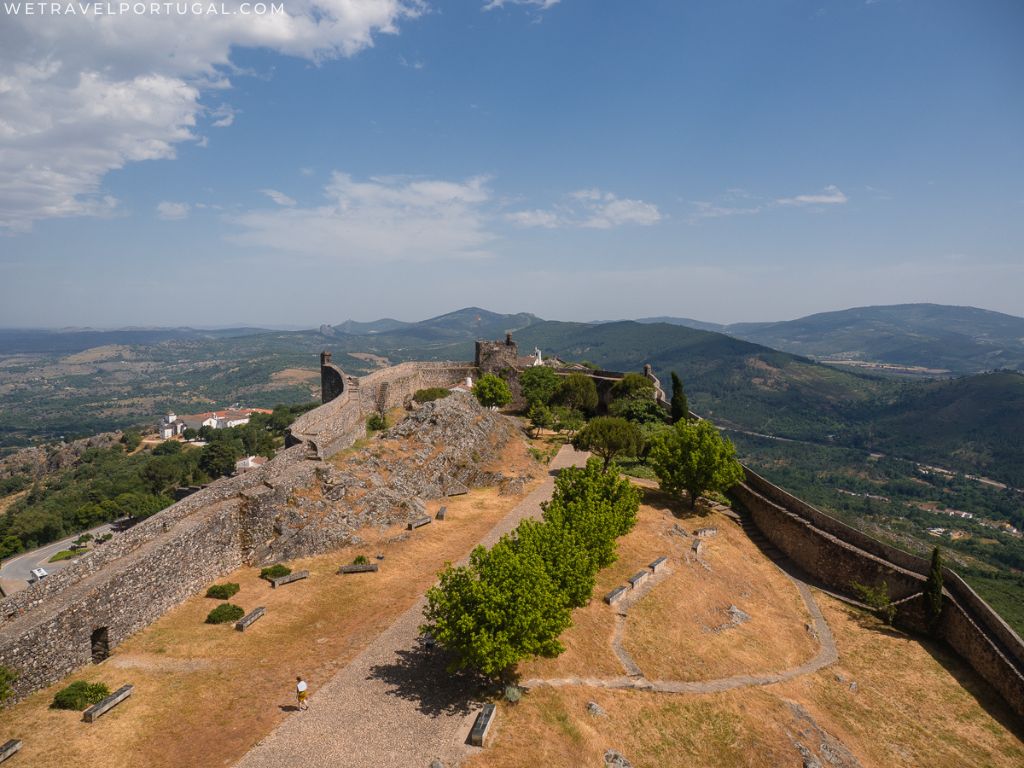
Marvão is a stunning walled village offering panoramic views of the surrounding Serra de São Mamede. Perched high on a hilltop it has an exceptionally well-preserved castle and typically narrow streets. It’s a tiny village but offers so much historical character.
Vila Viçosa – Royal History and Marble Architecture
Vila Viçosa has the charming nickname of the ‘Princess of Alentejo’ an immaculate town that boasts a castle, a palace, churches, and convents. It was somewhat of a resort town, becoming the main royal holiday residence of D. João IV in the 1640s. Vila Viçosa is also known as the “Marble Town,” showcasing its historical wealth through its marble architecture. Key attractions include the Ducal Palace and the Marble Museum, highlighting the importance of marble in the region’s history.

Porto Covo – Beaches and Coastal Walking
Porto Covo is a compact white-and-blue coastal village surrounded by beaches, rocky coves and walking routes. It is one of the most convenient bases for exploring the Alentejo coast and nearby sections of the Rota Vicentina.

Rota Vicentina – Walking the Alentejo Coast
The Rota Vicentina is a network of long-distance and circular walking routes across southwest Portugal. Its best-known coastal route, the Fishermen’s Trail, follows cliffs, dunes, beaches and fishing villages between the Alentejo and the Algarve.
The exposed terrain and loose sand can make longer stages demanding, particularly in hot weather, but shorter sections provide an excellent way to experience the protected coastline.
Taste the Alentejo: Food, Wine and Regional Traditions
For me, one of the best things about the Alentejo region is its incredible food. Food in the Alentejo is shaped by the region’s agricultural landscape and a tradition of making the most of simple, local ingredients.
Bread, olive oil, garlic and fresh herbs form the basis of many classic dishes, including açorda alentejana, migas and hearty soups. Pork is another regional staple, particularly porco preto, while lamb, game, river fish and seasonal vegetables feature prominently across local menus.
The region is equally known for its cheeses, cured meats, olive oils and traditional sweets. Look out for sericaia, often served with Elvas plums, as well as convent-inspired desserts made with eggs, sugar and almonds. Évora is a fantastic place to dive into several local pastelarias and really go beyond pastel de nata when it comes to egg based pastries!
Wine is central to the Alentejo’s identity. Vineyards stretch across much of the region, producing bold reds, fresh whites and increasingly varied natural and low-intervention wines. Visitors can tour estates, join tastings and learn about traditional talha wine, which is fermented in large clay vessels using a method with roots stretching back centuries.
Wine Tasting – A Taste of the Alentejo
Visiting a winery is a brilliant experience and great for anyone looking to learn about this relatively undiscovered wine region.
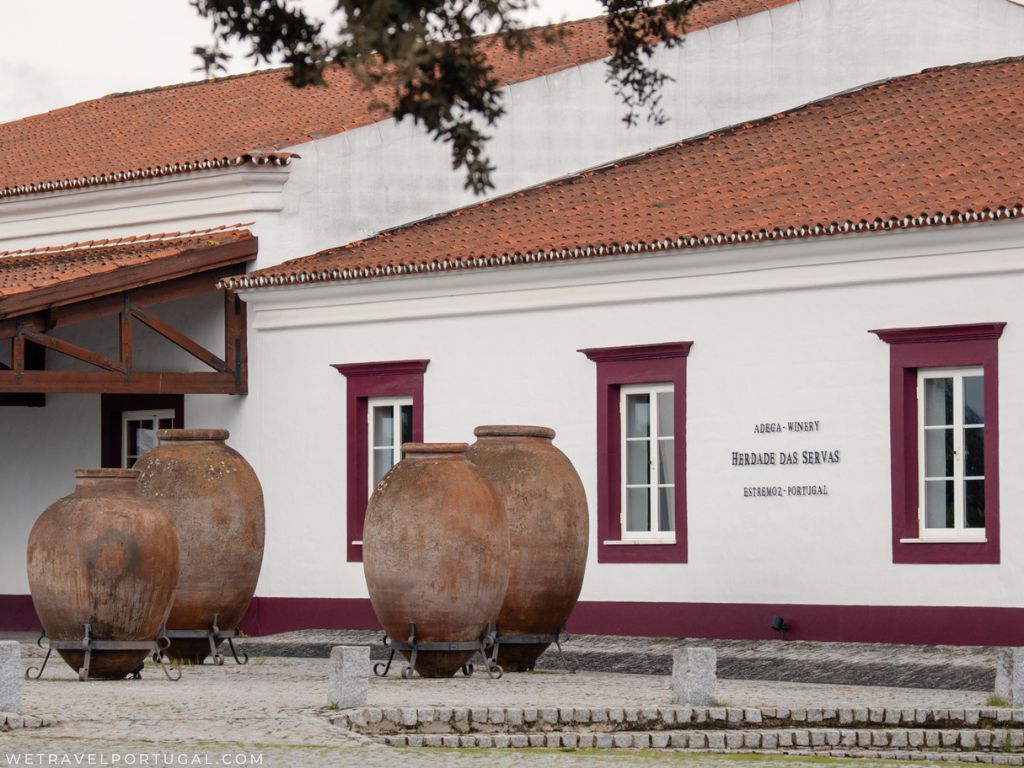
The region is dotted with grand estates and wineries in the countryside, and in the towns and cities you’ll find plenty of wine bars. To get the full experience, we do recommend visiting at least one winery and recently visited Herdade das Servas ourselves. They’ll take you through the vineyard, the estate, and the production facilities before taking you through the cellar for an exclusive tasting.
When to Visit Alentejo
Alentejo’s climate and location makes it a great year-round destination, with something to see and do in every season. The spring (March to May) is particularly beautiful with wildflowers blooming and makes exploring the outdoors a joy. Summers can be exceedingly hot, in some places reaching above 40 degrees which does mean you should be careful in choosing where to go. However, sticking to the coastline like Porto Covo or Vila Nova de Milfontes, will keep you cool and give you somewhere to cool off!
Autumn (September to November) offers pleasant temperatures and the grape harvest season. While winter is the quietest, you can still expect bright sunny days, but cooler nights. Again, great for getting outdoors and tackling some of the excellent hiking routes or passadiços.

Getting to the Alentejo
The region is accessible via both Lisbon’s international airport, and Faro’s international airport. However, public transport options are far better via Lisbon, than they are from the Algarve. Lisbon has both road and rail connections to Évora.
The Linha do Alentejo (The trainline of the region) will take you from Lisbon through to Évora, Alvito, Cuba and on to Beja. Additionally, from Lisbon you have multiple bus services from the likes of Flixbus, and Renex which offer bus services to Évora and a few other cities.
From the Algarve, there is only one trainline that takes you into the Alentejo, and that’s the main route to Lisbon. It makes a stop in Amoreiras-Odemira, a small town with limited onward transport options. If you want to use trains to get to Évora, you’ll need to go through Lisbon and connect on the above mentioned Linha do Alentejo. Alternatively, Renex offers a bus service with stops in Castro Verde and Beja before getting to Évora.

Where to Stay in the Alentejo
Choose Évora for a first visit, restaurants and easy access to the central region. Monsaraz or Reguengos de Monsaraz work well for Lake Alqueva, wineries and dark-sky experiences. Marvão and Castelo de Vide are best for the Serra de São Mamede, while Vila Nova de Milfontes or Porto Covo suit travellers focused on the coast and the Rota Vicentina.
Do You Need a Car to Explore the Alentejo?
You can visit Évora and some of the region’s larger towns by train or coach, but a car is the most practical option for exploring villages, wineries, prehistoric sites and rural landscapes.
A car is particularly useful for Monsaraz, Marvão, the Alqueva area and multi-stop itineraries. Travellers staying only in Évora or visiting the coastal towns may be able to manage without one, although local connections are often limited. If you’re looking at renting a car, read our guide to car rental here! It covers everything you need to know and how to avoid the extra costs.
Start Planning Your Alentejo Trip
For a first visit, Évora offers the easiest introduction to the region, with historic sights, restaurants and good access to nearby towns and wineries. Travellers with more time can continue to Lake Alqueva, explore the fortified towns of northern Alentejo or combine the interior with several days on the Atlantic coast.
The Alentejo rewards slower travel. Rather than trying to cover the entire region, choose one or two areas and allow time for the landscapes, food and small towns between the major sights.
