
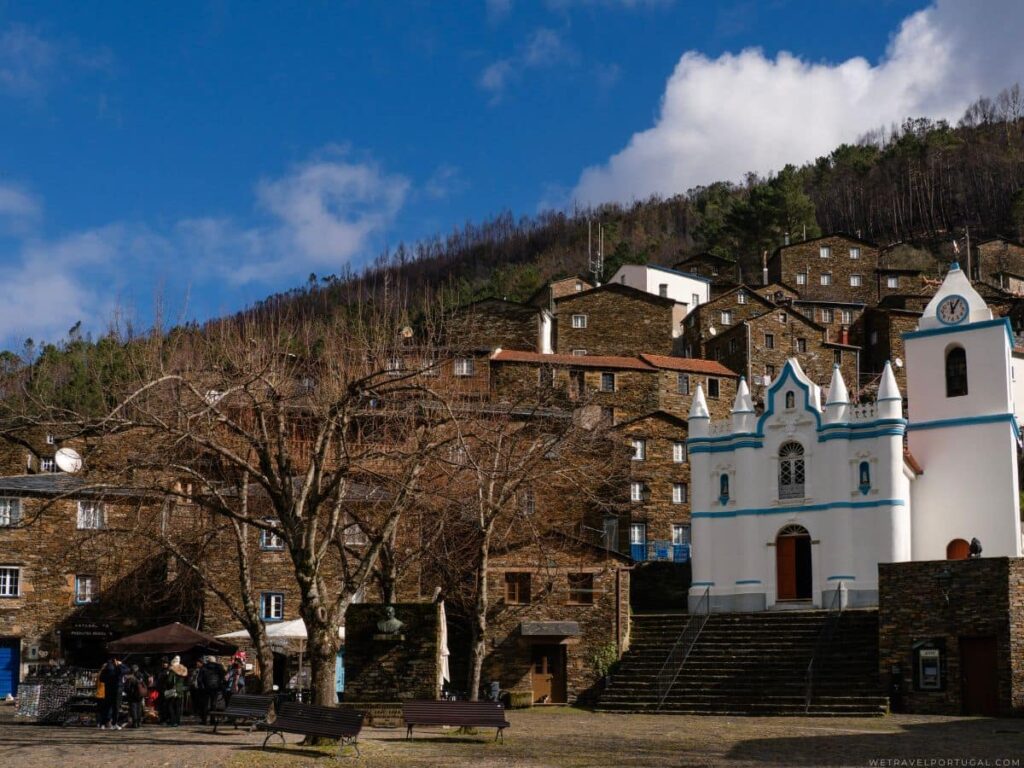
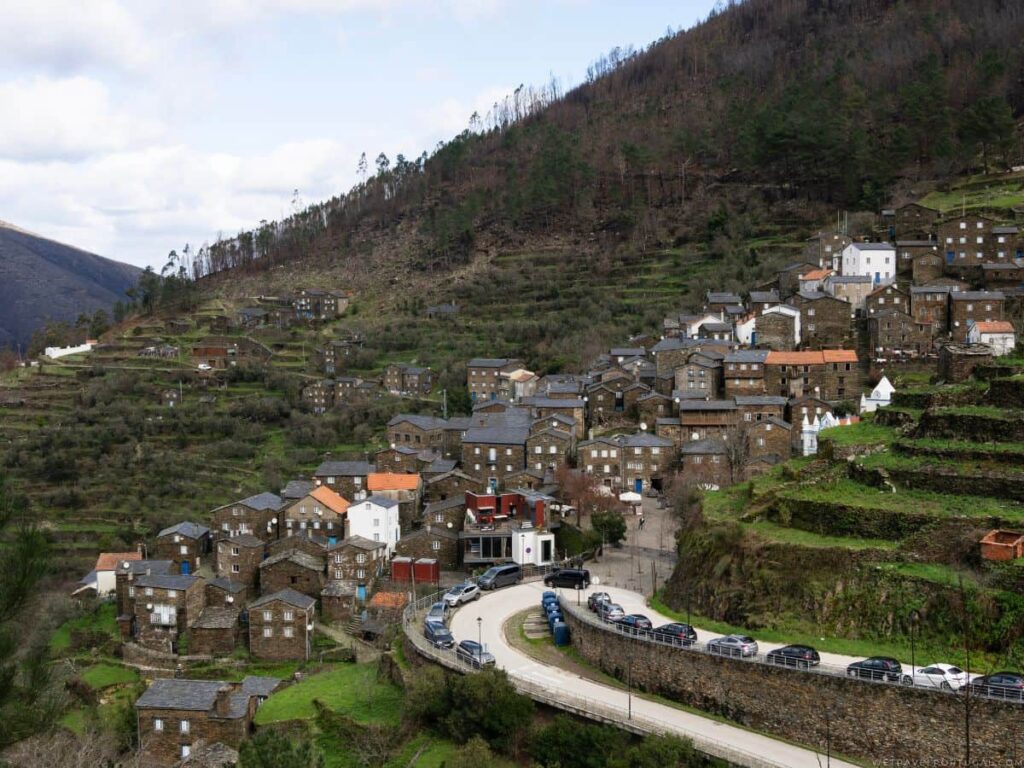
Piódão is a stunning schist village hidden in the central region of Portugal. It’s deep in the Serra do Açor, a small mountain range littered with tiny villages, small rivers, and forest trails. Piódão lies on a small mountainside with layers of dark schist stone, and its houses almost stacked on top of each other. It’s a beautiful village and place to explore.
Where Is Piódão?
Piódão sits in the municipality of Arganil, within the Coimbra District. It’s part of the Aldeias Históricas network – a group of Portugal’s most historically significant villages. Despite this significance, and how well known it is, it still feels remote and rarely gets that busy.
Driving times:
- Around 2.5–3 hours from Lisbon
- About 2 hours from Porto
- Just over 1 hour from Coimbra
The final stretch of road snakes dramatically through the mountains.
Can you Get to Piódão with Public Transport?
Unfortunately, not, the closest you can reliably get is the city of Coimbra. From there you’ll need a local taxi. For the simplest exploration, you’ll need a rental car, or book a specific tour that visits Piódão.
Piódão’s Extraordinary Architecture
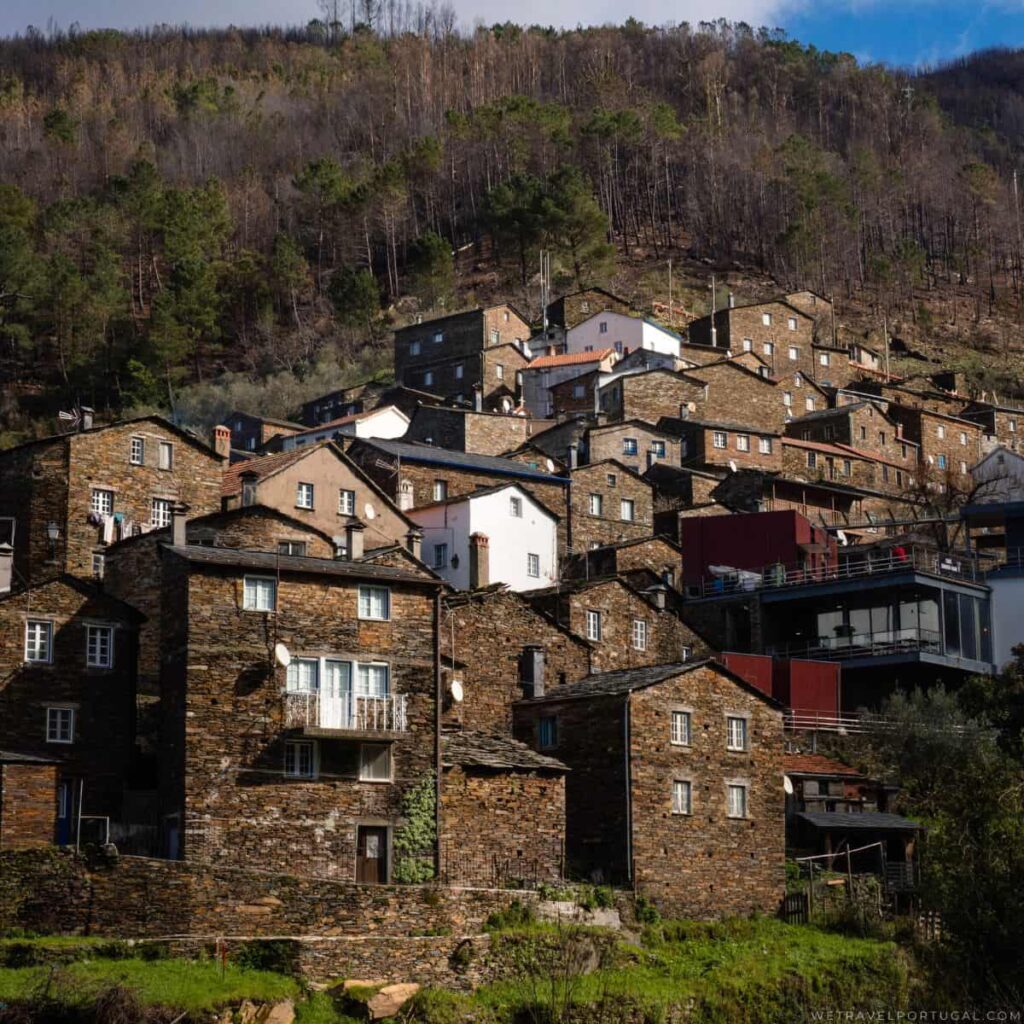
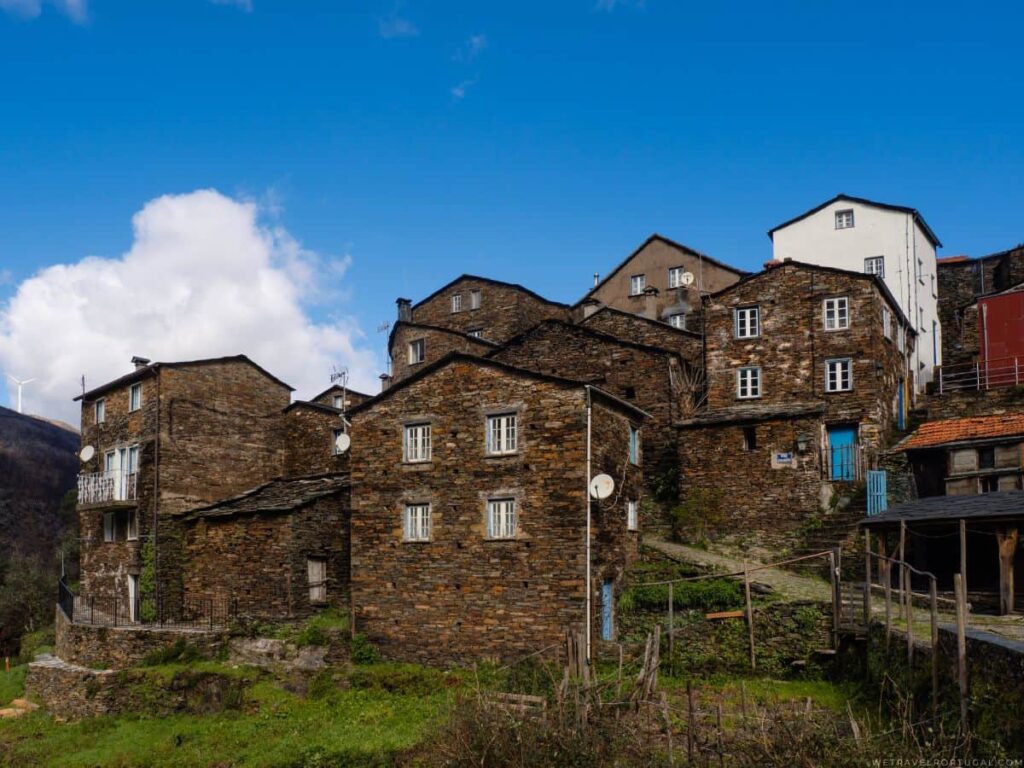
What makes Piódão so special is the material consistency of almost all of its buildings. Piódão is a schist village, a village almost entirely constructed of locally sourced schist, a dark metamorphic stone that blends seamlessly with the surrounding landscape.
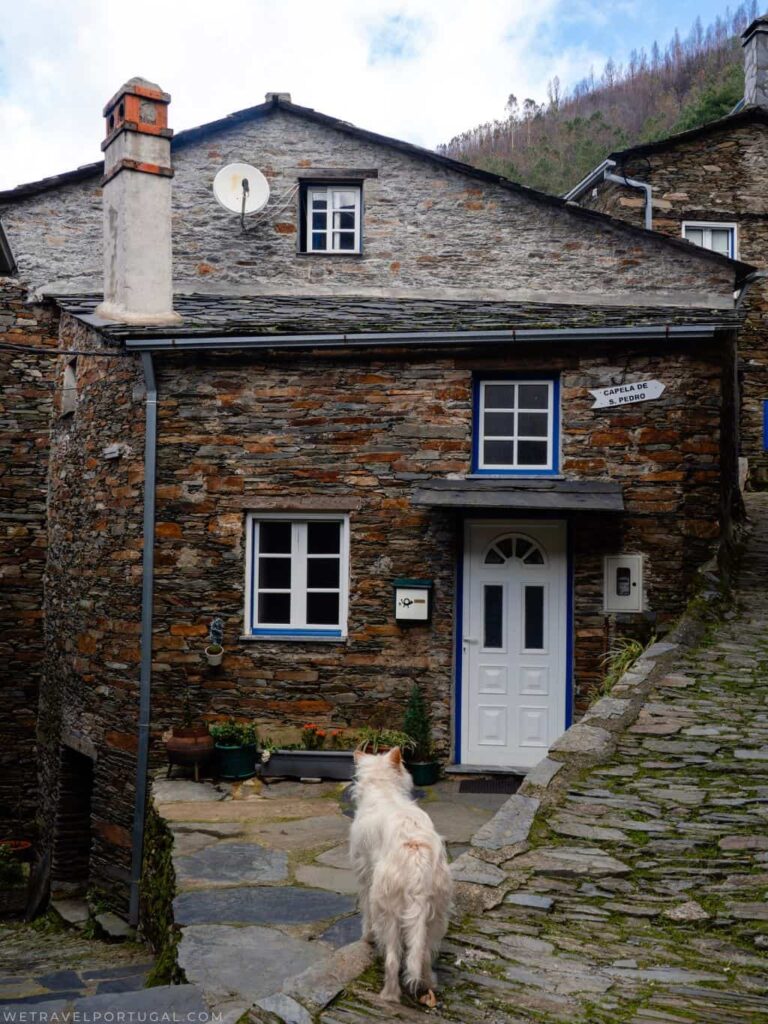
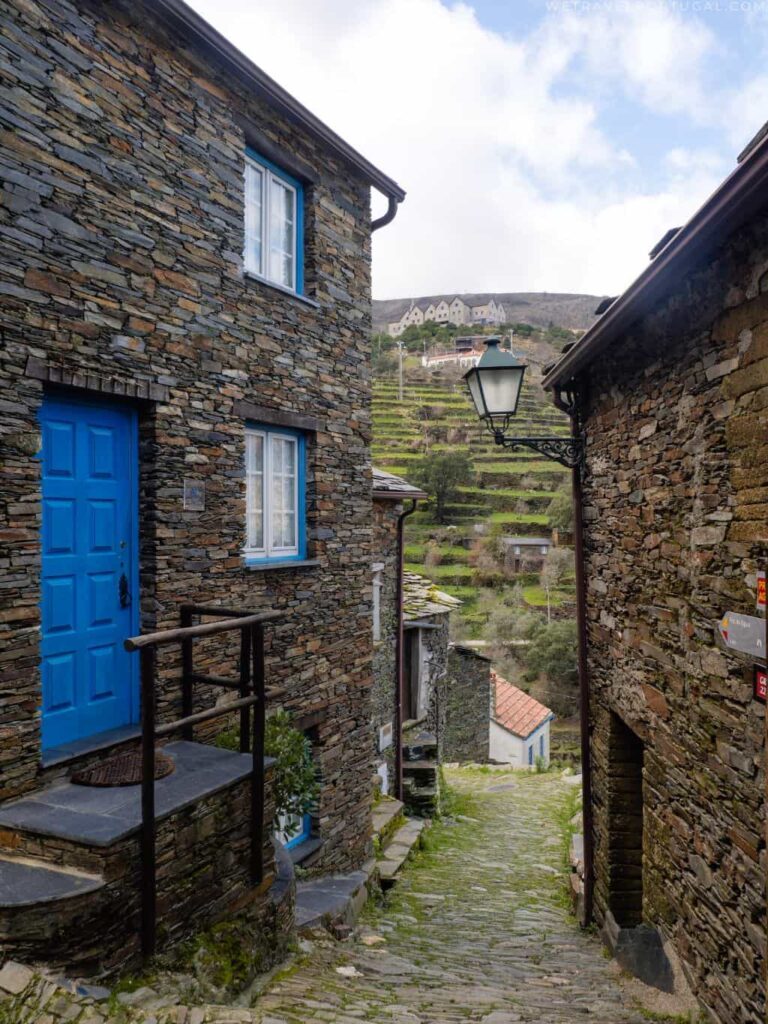
The houses here are compact, multi-level, and connected by steep stone paths rather than conventional streets. As well as its stone signature, Piódão has another, the colour blue. You’ll find doors, shutters, frames, and railings all coloured in bright blue.
What to See and Do in Piódão
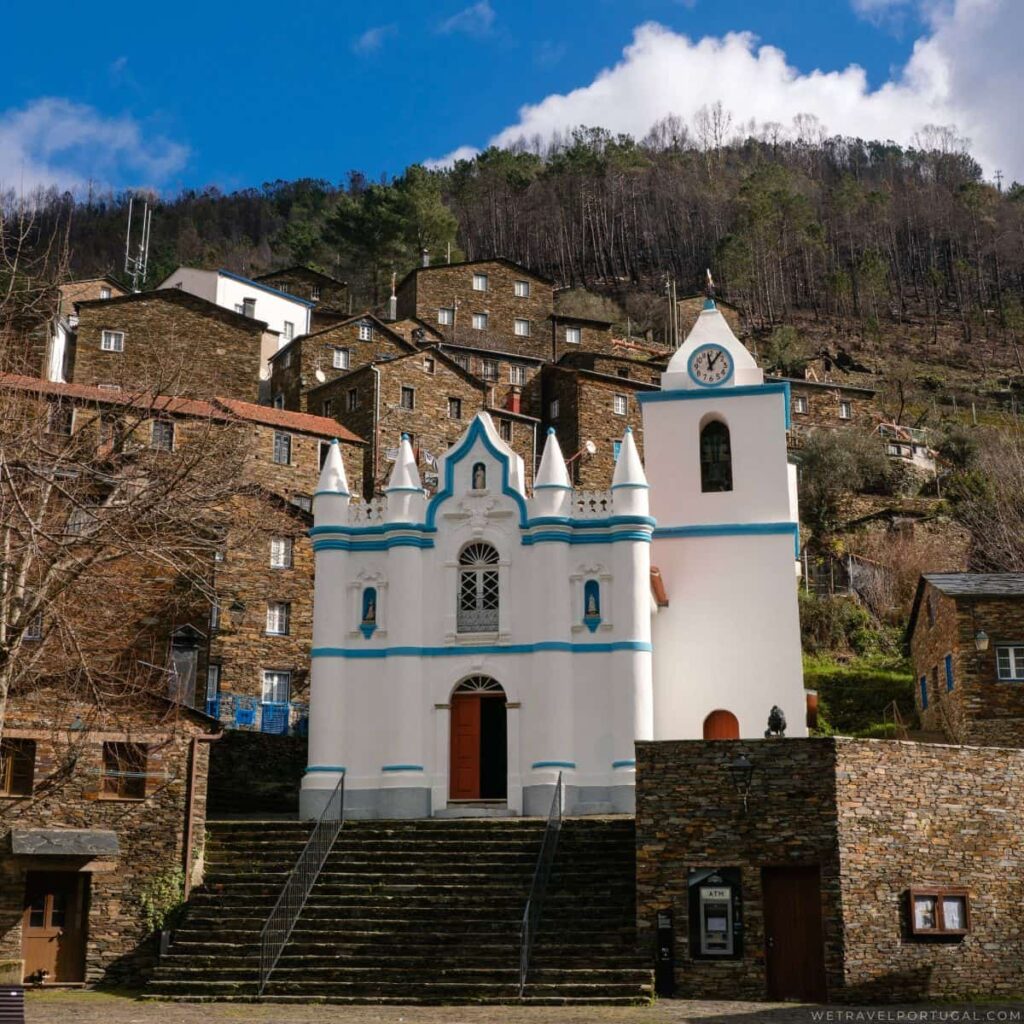
Piódão is relatively small, but you’ll find a more than a few things to marvel at! The best place to start your visit is the emblematic Largo Cónego Manuel Fernandes Nogueira. A public square where you’ll find several cafés, restaurants, and a bar. Directly facing the square is Piódão’s rather iconic church.
Igreja Matriz de Nossa Senhora da Conceição
It is one of the most visually striking churches in the region. The bright white façade and its bell tower is one of the only buildings in the village not in the ‘traditional’ colours. It is not really that well known why the church is so different to its surroundings, and to other churches in the region.
The church has a Neo-Baroque style, with several features that are often described as Moorish or African – the columned front, minarets and merlons. The only connection that exists for its design, is that parish priest Manuel Nogueira (the same who the square is named after) had a colleague from Mértola. A place which has a very similar church that was originally a mosque.
Visit the Village Museum
Also in the main square is the small tourist office, and the village’s museum (Núcleo Museológico de Piódão). It’s a small space, but offers some local insight on traditions and rural life here in this part of Portugal.
Explore the stone alleys – and meet the residents
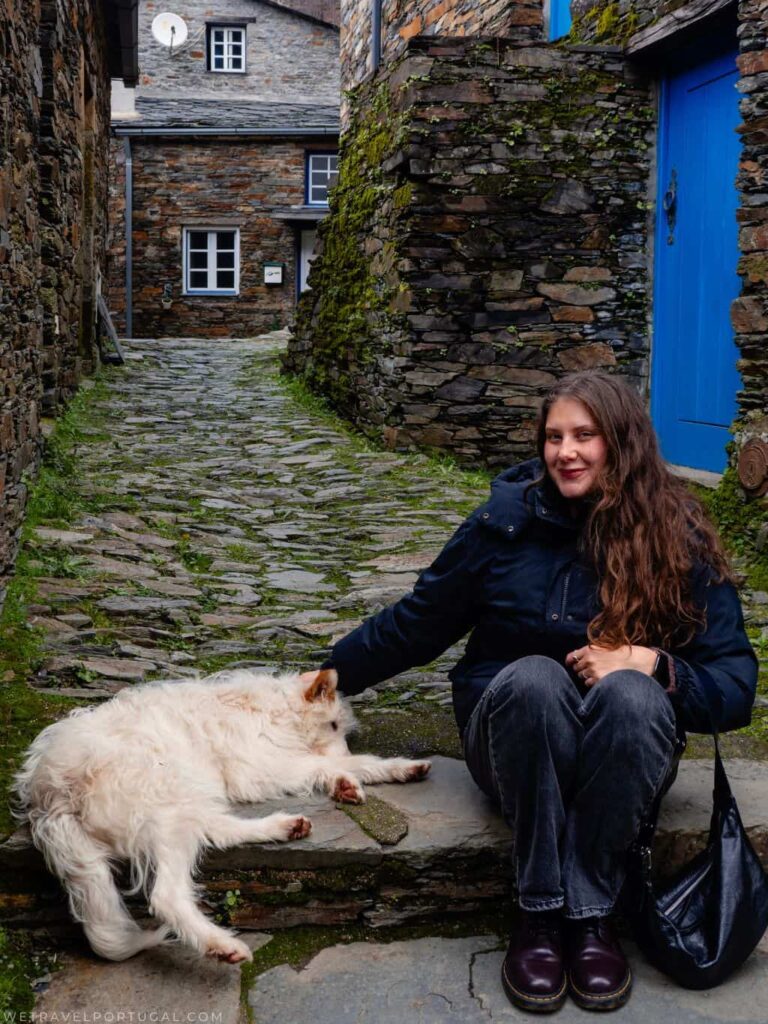
My favourite thing to do in Piódão is to simply explore! In pretty much every direction are tight cobbled streets, narrow pathways, and beautiful houses. There’s so many angles to see. The tiny streets, lack of vehicles, and general friendliness, means that seemingly a lot of people let their pets roam here. Which means that you’ll definitely meet some friendly dogs and cats here!
Hike to the Top of Piódão and Enjoy the Views
It’s a short walk by distance (180m) if you follow the most direct path but it’s easy to take detours when you’re looking for the most photogenic of streets and houses. At the very top of Piódão you’ll find Eira Comunitaria. It’s an opening at the top of the village, where originally the local community would have threshed the grain on the hard floor. Although it’s not used for that purpose today, it’s a open space which gives the best views of the roof tops back into Piódão.
Take a dip in the Pria Fluvial – if it’s warm enough
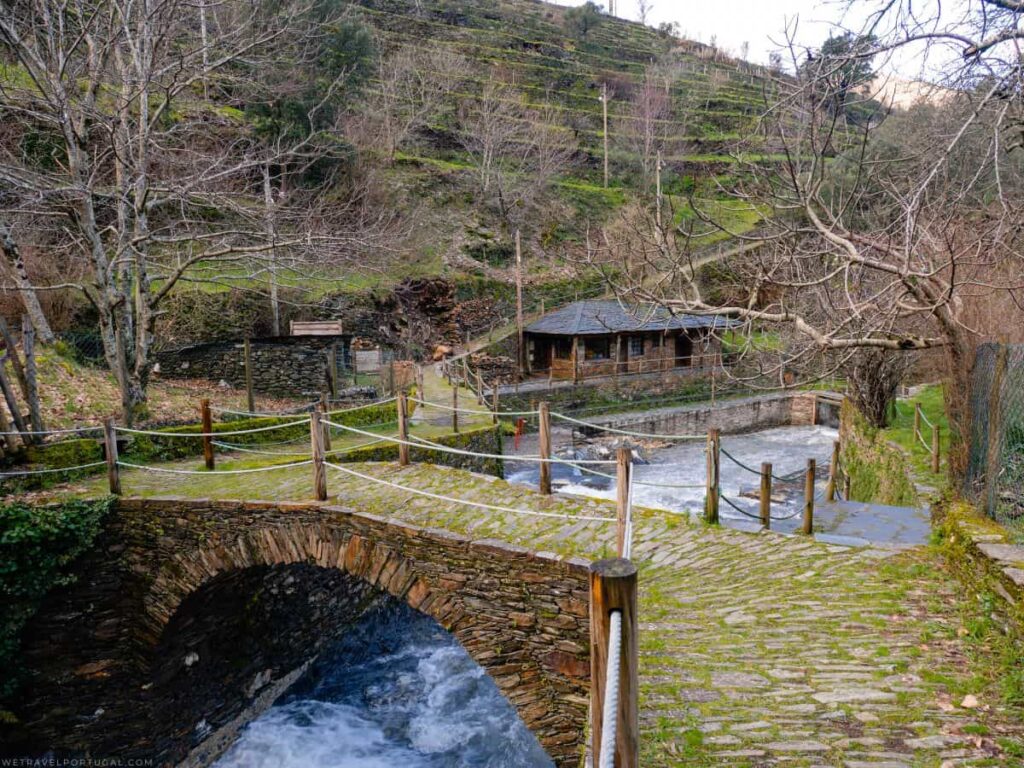
Once you’ve explored the many winding streets of Piódão, you can head to the lowest part of the valley and find the river. During the warmer months, the sluice gates are closed and water gets trapped in the small canal. It then becomes one of my favourite river beaches in Portugal (Praia Fluvial de Piódão).
During the hot months, this is where many of the locals and tourists come to cool off. It might be over 100km to the nearest coastal beach but Piódão has its very own. You’ll even find life guards, a small café, and a picnic and bbq area. Pria Fluvial’s are a charming part of the more rural side of Portugal.
Hike to Foz d’Égua
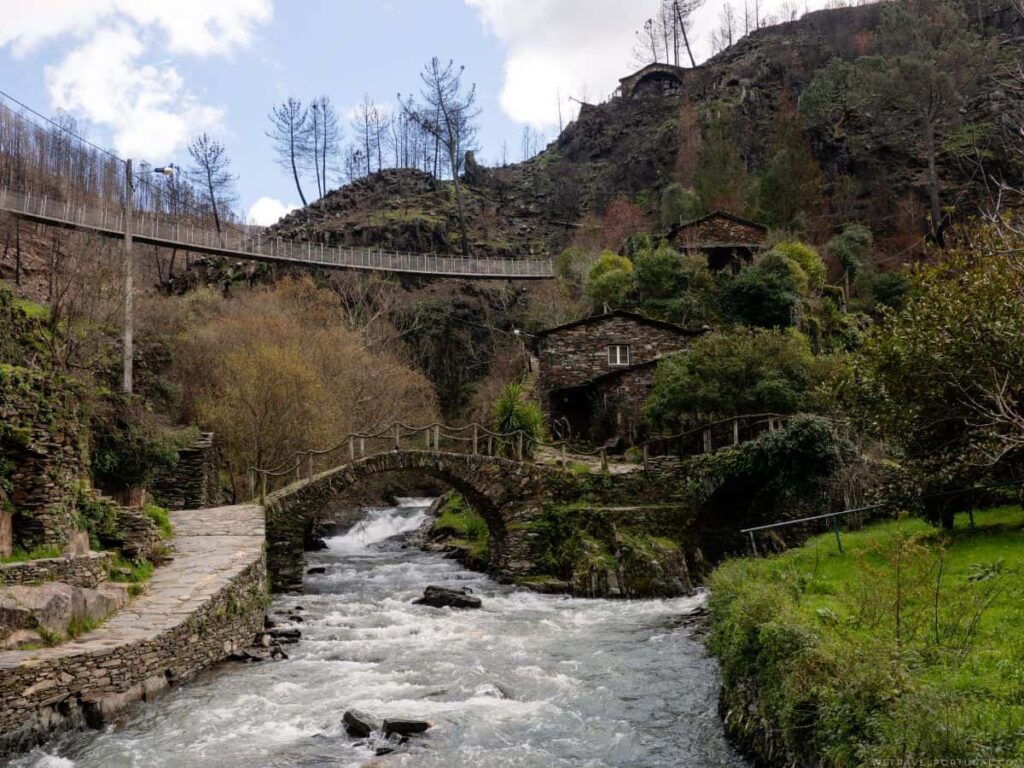
That small river, flows downstream to an even tinier village called Foz d’Égua. Foz d’Égua is famous for its river beach spanned with 2 historic schist bridges – another almost fairytale location in this part of Portugal. Further up is large suspension bridge that spans the valley, and leads to a small religious site dedicated to the Virgin Mary.
The full route is the PR2.1 Piódão – Foz de Égua and it’s a 6km return trip to follow the river and return. If you can’t commit to the full hike, you can also drive to Foz d’Égua.
Where to stay in Piódão
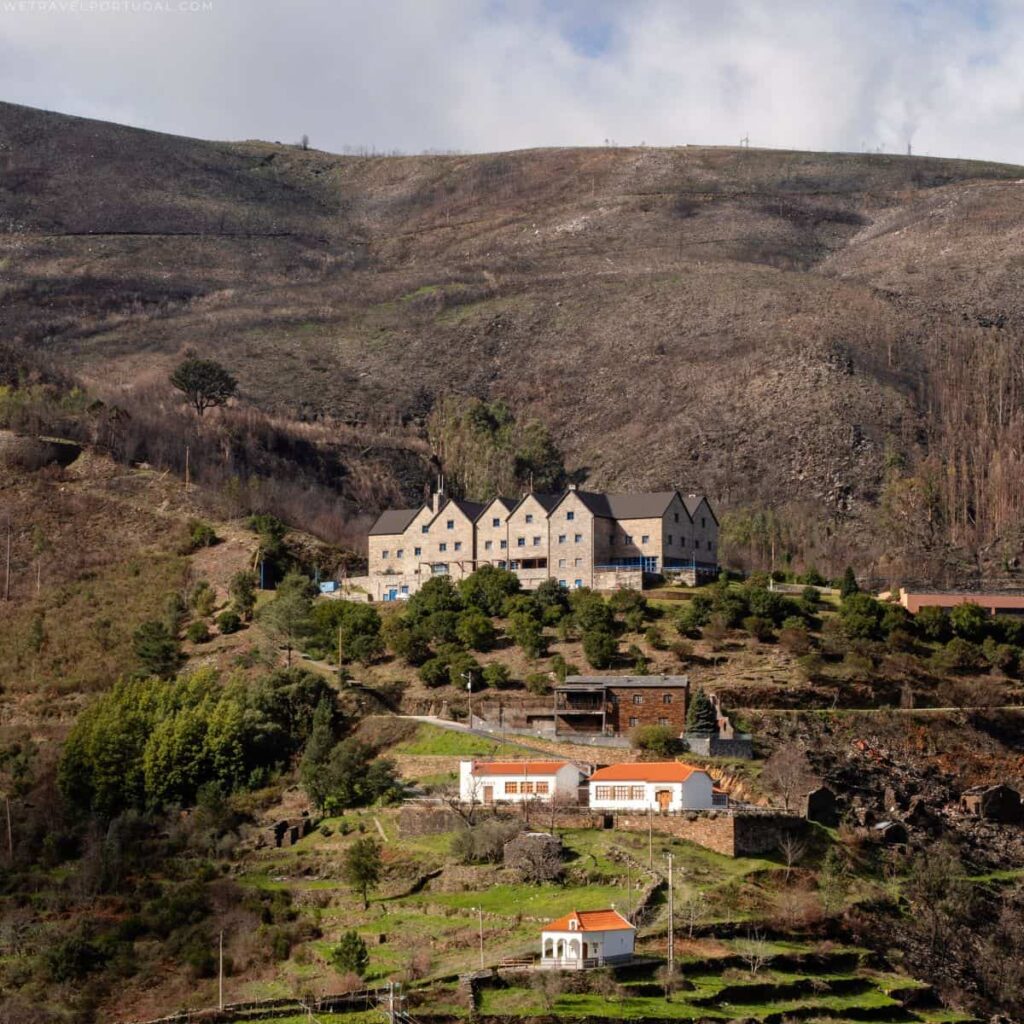
Although Piódão is small, it makes an enticing overnight stop when exploring this part of Portugal. There’s a small selection of tourist accommodation in the village itself, if you want the experience of staying in a schist house. Or on the outskirts of the village is the INATEL Piodão. A moderate sized hotel that looks like a large lodge built out of the local schist.
Need to Know – Piódão
- Piódão is relatively small, but the steep, cobbled streets mean good footwear is essential.
- There is a limited amount of parking close to the village – during the peak months you should try to get here early.
- Accommodation is limited to a couple of Airbnb’s and one hotel, if you plan to stay you should book early.
- One thing to bear in mind is to be respectful – these are people’s homes. So be aware of who and what you might be photographing
Piódão and Wildfires
In August 2025 Piódão and the wider region suffered some of the worst wildfires in Portugal. The ICNF estimated it was the biggest fire ever seen in Portugal, with the largest amount of burned area (at around 64,000ha). The village itself was unscathed, but the wildfires burned close and as you approach the area you’ll see much of the damage. The trees, and forests are recovering slowly, but wildfires are something to be aware of during the warmer months.
Should you Visit Piódão?
Piódão is one of my favourite schist villages, and for anyone exploring the central part of Portugal, a place you should absolutely stop and explore. In the summer months you’ll find a place to cool off, eat some amazing local food, and some of the best hiking trails in Portugal.
