
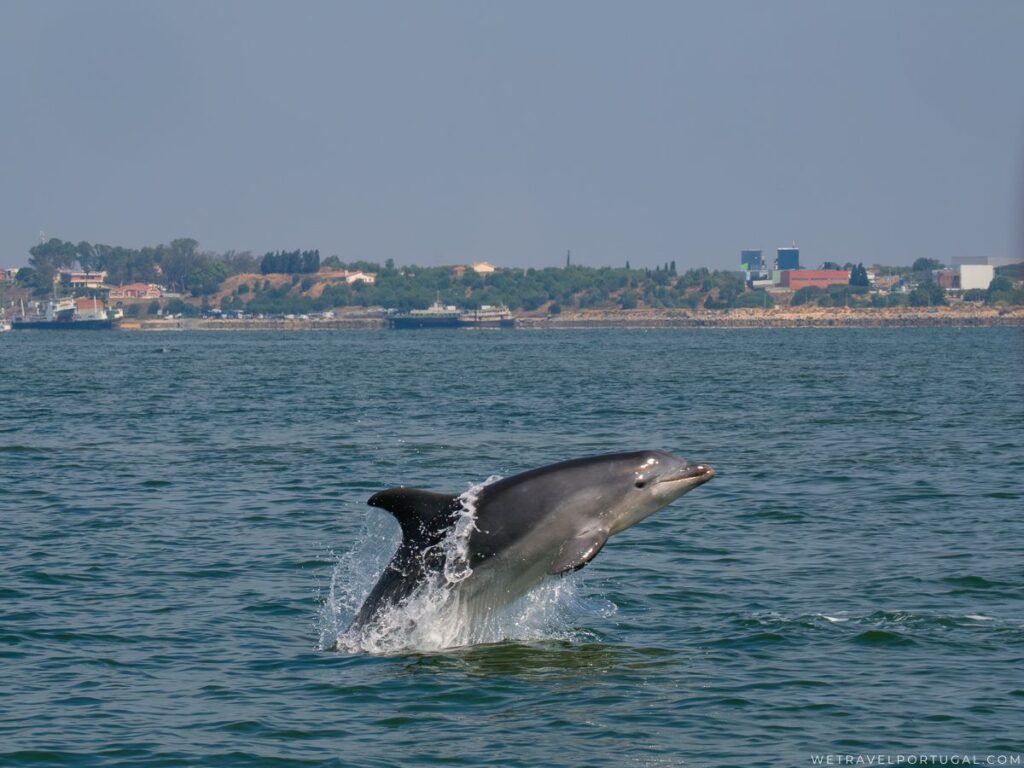
Around 45 minutes south of Lisbon is the Sado Estuary, home to Portugal’s only population of resident dolphins. Watching them in their natural habitat is a truly unique activity that can be done nowhere else in Portugal. In fact, it’s one of only five places in Europe where you can observe a pod of resident dolphins.
Sado Estuary Nature Reserve (Reserva Natural do Estuário do Sado)
The Sado Estuary occupies over 230 square kilometres and the entirety of it is a protected area known as the Sado Estuary Nature Reserve (Reserva Natural do Estuário do Sado). A wide variety of unique habitats are found here, ranging from marshes, mudflats, dunes, salt marshes, and even coastal lagoons. It’s a protected area and home to over 221 bird species, and ecologically important as the home of the only resident population of dolphins in Portugal. One of only three resident populations in Europe!

The Sado River (Rio Sado)
The Rio Sado is a 180-kilometre-long river in Portugal, that flows from deep within the Alentejo region all the way to Setúbal. It’s notable for being the only river in Portugal that flows from south to north, its springs lie near the village of Ourique. A short distance from Alcácer do Sal, the river flows into the wide estuary called the Sado Estuary.

Common bottle nose Dolphins in Setúbal
The dolphins that can be found in the Sado Estuary are Common Dolphins (Tursiops truncatus), and they are found around the world. Typically, the dolphins are split into two groups Transient (ranging over large areas) or Resident, by resident populations we mean groups of dolphins that inhabit one place year-round. There are 5 resident populations in Europe. These are found in Scotland, Wales, Ireland, and here in the Sado Estuary near Setúbal.

Sado River Dolphins
The dolphins have been monitored in the estuary by the ICNF for over 40 years. In 2025, the family group is made up of 27 named individuals. They are closely monitored and identified by their dorsal fins and colouration.
Meeting the Sado Estuary Dolphins
The first thing to mention is that this family group of Bottlenose Dolphins are wild animals in their natural habitat. All tour operators follow a strict set of standards maintained by the ICNF. There is no feeding, no encouragement, and no interaction with the dolphins, other than observation. Attempting to touch the dolphins is strictly forbidden.

Dolphin Watching from Setúbal
Most boat tours depart from Setúbal, and some tours make additional stops at the dock in Troia. There are multiple options, ranging from smaller inflatable speedboats to larger open decked boats and catamarans. Choosing one really depends on the type of trip you are looking for, and your comfort levels.
The faster speedboat type trips advertise the ability to find dolphins more quickly and being able to cover more ‘ground’. While the catamarans and larger boats are limited in areas they can search within the time frame of the tour. Additionally, though, the larger boats have bathrooms, and some even have bars and snacks. Something you won’t find on any of the smaller boats! It really depends on what type of tour you are looking for!

Booking Your Dolphin Watching Trip
On our most recent trip we went with Sado Emotion, tickets can be booked directly or on platforms like Get Your Guide. They boast a 99.5% success rate at finding dolphins, and will give you a free voucher to come back if you don’t get to see them.
Is Observing the Sado River Dolphins Ethical?
By all accounts, observing the dolphins exhibiting their natural behaviours in the Sado Estuary is ethical. First and foremost, you must make sure to only observe the dolphins with a licenced operator from the ICNF. These tour operators follow a strict set of guidelines designed to reduce the impact of tours and allow the pod of dolphins to thrive.
These guidelines include:
- Not approaching the dolphins from the front, only from a 60-degree angle from the rear.
- Maintain a course parallel to and behind the dolphins so that they have a free field of 180º in front of them.
- Not actively approaching closer than 30 meters to any dolphin – however, once the boats are stopped the dolphins will get much closer.
- Not to swim with, feed, touch or interact with the dolphins.
- Not to split up groups of dolphins.
- To observe pods of dolphins for a maximum of 30 minutes.
There are quite a few more rules laid out by the ICNF and the full code of conduct is available online, but you can get the gist from these examples. These are wild animals, in their natural habitat, and the ICNF take their protection extremely seriously. In fact, on our recent observation trip we saw the ICNF boat intervene to stop a private hired boat from getting too close.

What to do after your dolphin watching tour?
With only 30 minutes of observation allowed, many of the tours include additional extras, viewing the coastline and beaches of Arrábida, stop offs on sandbanks for swimming, and even lunch if you chose a large boat!
For us, we think its best to stop off at the dock in Troia and spend the afternoon on some of the best beaches in Portugal. If you’re lucky, you may even get to see more dolphins.
